
Original article available online through The Virginian-Pilot.

The family of an inmate who died by suicide at the Norfolk City Jail reached a $950,000 settlement in a federal lawsuit filed in federal court against the Norfolk Sheriff’s Office and former staff, whose actions were found to have led to the inmate’s death.

The lawsuit was filed by Jamie Vinson, the mother of Philemon Vinson, 24, who died by suicide while in custody in 2022 on a misdemeanor charge.

“Inmate mental health is an important and often overlooked issue,” said Jamie Vinson’s attorney, Randy Singer. “If this case can shine a light on that and create reforms, it won’t bring Philemon back but maybe it can make sure this doesn’t happen to any other family.”

Singer said the Sheriff’s Office is the only defendant he can think of throughout his career that voluntarily made a settlement public and committed to reforms.

During Philemon Vinson’s intake screening, a nurse assistant working under a contract with a health-care provider noted he had feelings of hopelessness or helplessness, and that he was depressed.

Vinson’s answers during the screening required he be urgently referred to mental health care or recommended for suicide watch, a statement of facts attached to the settlement said. The nurse did neither.

A day after he was booked, Vinson’s mental health paperwork was reviewed by the jail’s director of mental health services, Anne Purkerson, and for the next four days she did not see him for a mental health evaluation, said the statement of facts.

After Vinson died, Purkerson “fraudulently wrote a progress note” to make it look as though she had met with him, and “falsely claimed” that he’d told her he wasn’t suicidal, according to the statement of facts.

Purkerson didn’t meet with Vinson because of the shortage of mental health professionals in the jail at the time, according to the statement of facts. Her position as a mental health professional was one of four in the jail that housed about 750 inmates, a majority of whom experienced mental illness.

Two of the mental health positions staffed by the jail’s former third-party health provider, Wellpath, were vacant at the time, and Perkurson’s colleague employed by the Norfolk Sheriff’s Office was on leave, according to the statement of facts. Purkerson resigned shortly after Vinson’s death. Wellpath declared bankruptcy during the litigation of the lawsuit.

Five days after his mental health screening, surveillance footage attached to the lawsuit showed Vinson preparing to take his own life for over an hour, while the deputy assigned to perform safety rounds in the hallway of his cell passed several times without peering inside. Hours later Vinson was found unresponsive in his cell when the deputy delivered dinner at 4 p.m.

Jamie Vinson learned about her son’s death when a Norfolk police officer called her late that night. The next day, she learned from a Facebook post that he had died by suicide.

“If not for the lawsuit, to this day I would be walking around with speculation and what was said on social media,” she said.

After her son’s death, Jamie visited the jail and courthouse, and called police and the sheriff’s office asking for answers.

“No one ever contacted me or called me back,” she said.

Over three years later, Jamie said, she met with Sheriff Joe Baron last week.

“When I heard about how Ms. Vinson got bounced around like that, I didn’t like what she experienced,” Baron said.

Notifying a person’s family about their death in custody used to be the responsibility of Norfolk police — the agency conducting the death investigation. But the sheriff’s office now requires deputies to accompany police, extend condolences and provide the family with the sheriff’s phone number.

The hope, Baron said, is that a family has access to timely and accurate information about an inmate.

It’s one of a series of reforms taken on by the Sheriff’s Office — in part a result of the settlement.

Others include staffing registered nurses instead of nurses’ assistants to complete intake screenings of inmates, increasing annual spending on medical and mental health to $9.5 million and raising the number of mental health staff positions in the jail from four to ten – eight of which are currently filled, according to Jamie Bastas, the public information officer.

Deputies are required to undergo additional training to highlight the importance of cell checks and be able react in the case of a crisis.

Many of the reforms already were underway when Vinson died, said Norfolk’s undersheriff, Michael O’Toole. He said the office was in the process of terminating their contract with Wellpath and finalizing negotiations with a new provider: Medico.

Suicide is a leading cause of death among inmates, and sheriffs across Hampton Roads have said that handling people with serious mental health issues is among the greatest challenges in running jails.

Over 60% of the Norfolk jail’s 719 inmates experience mental health challenges — 10 or so of which are housed separately and considered to be a danger to themselves or others, said O’Toole.

“Our job isn’t to punish people,” said Baron. “It’s to take care of them until they reenter society. How they reenter society is determined by how we treat them.”

Jamie Vinson said her only son was smart and funny, a passionate football player, a father of three and an artist who had ambitions of becoming a tattoo artist.

“I just hope this is a wake up call for people to understand that even though they are inmates they are still people,” she said.
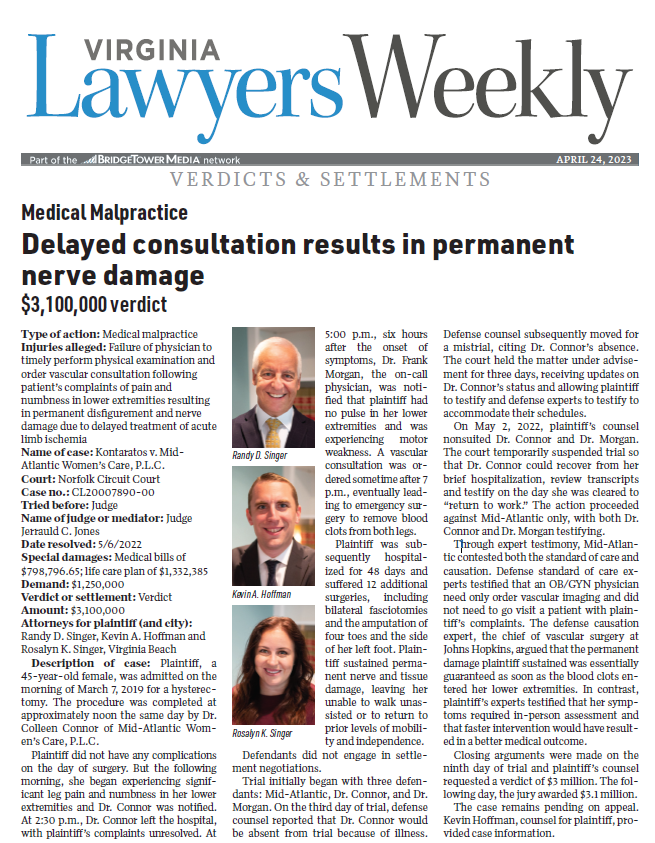
2022 VLW Article

Original article available online through the Richmond Times Dispatch.

MONTROSS — A four-man, three-woman jury Thursday night awarded an $8 million judgment against a Northern Neck restaurant owner whose wife was found dead of exposure on their 40-acre, snowbound property in February 2010.

Jurors deliberated just more than two hours after a three-day trial before issuing the verdict on behalf of the estate of Sally Rumsey, 42, and directed that the money be parceled out to Rumsey’s 28-year-old daughter and a 21-year-old daughter Rumsey had with defendant Stephen Andersen, 62.

Family members and supporters of Rumsey broke into tears at the decision, which also included a plaintiff’s verdict in favor of Sarah Thrift, Rumsey’s older daughter, whose lawyer argued that Andersen should not benefit from Rumsey’s estate. The disbursement of the estate will be argued at some future date. Defense lawyer John P. Harris III said he will appeal the verdict.
Plaintiff lawyer Randy Singer said that the award was a “reflection by the jurors of the regard held for Sally Rumsey in this community.” In court filings nearly four years ago, Singer asked for $10 million in the case.

The panel awarded $6 million in compensatory damages and $2 million in punitive damages.

The jury’s foreperson said jurors voted unanimously in both cases on the first vote and that jurors felt Rumsey’s death may have been prevented had Andersen done more to locate her on a frigid winter night. Andersen did not report Rumsey’s disappearance for 48 hours as a blinding snow storm covered the Northern Neck. Andersen testified he did what he could to locate his wife on the property but assumed she had left the area after an argument Feb. 5. Her frozen body was located by a Virginia State Trooper near the home on Feb. 9.

Thursday’s proceeding was highlighted by strained testimony from the defendant. Even his own lawyer told the jury that Andersen struggled to explain what transpired the day his wife disappeared. She was found four days later partially covered with snow about 80 yards from the couple’s rural home north of Haynesville.

“Even if you hate him, it doesn’t mean you don’t treat him fairly,” attorney John P. Harris III told the jury on Thursday. “He’s just who he is — he’s petrified. He runs off his mouth and tries to explain.”

In his 75-minute appearance on the stand Thursday, Andersen at one point paused for more than a minute wringing his hands and shifting his posture trying to answer a question about his belief of how his wife died.

In a sworn affidavit he had said that Rumsey didn’t commit suicide but “may have.” Thursday, after struggling uncomfortably, he said, “It’s the wrong answer because I believe she did commit suicide.”

At another point Andersen explained to the jury the reason 48 hours elapsed before he reported Rumsey’s absence to police on the evening of Feb. 7, 2010, Super Bowl Sunday.

“I didn’t think she was missing,” he said. “I just didn’t know where she was.”

Key conflicts in the case involved expert testimony dealing with the cause and manner of Rumsey’s death.

Kevin Whaley of the state medical examiner’s office testified that Rumsey was frozen solid and had to be “de-frosted” after she was discovered Feb. 9 and the body was brought to Richmond. Whaley refused to back off a conclusion that Rumsey took her own life, apparently wandering off from the home with a slightly elevated blood alcohol level and with a presence of the sleep narcotic Ambien in her system that was slightly above the high end of dosage levels.

Whaley conceded that the manner of death may have been accidental but flatly refused any suggestion that the death was a homicide.

Other testimony highlighted the odd position of Rumsey’s body, which was on its side but not in a fetal position in freezing weather. No snow was found beneath her body and a partially empty wine bottle was nearby but possibly propped up in fallen snow.
Singer, who argued the case on behalf of two plaintiffs, Rumsey’s estate and Thrift, presented other testimony that downplayed the death as accidental and incorporated testimony showing years of aggravation in a volatile marriage that even Andersen said was marked by agreements to simply ignore each other when arguments got heated.

“I would never have called police,” Andersen said when asked about the 48-hour lapse, explaining that Rumsey would not have wanted the community to know about troubles within the family or bring unwanted attention to herself.

Rumsey had returned days before her disappearance from a three-week bicycling trip to Asia, was exhausted, and almost immediately Rumsey and Andersen began sniping at each another, according to Andersen.

One argument was over no salt in the house for cooking, but Singer discounted a story told by Andersen to investigators that involved an eruption between the couple over Andersen’s viewing of pornography.

Andersen presented that scenario as police in Westmoreland began questioning him, but Singer told the jury that the porn argument was a ruse to explain why anger developed between the couple and why Andersen couldn’t account for Rumsey’s whereabouts.
Andersen told police he left the home to walk the dogs after the blowup only to return home and find his wife gone but key personal items still at the home, including car keys, credit cards and personal identification.

Rumsey, who had operated the popular Good Eats Café in Kinsale for nearly 20 years with Andersen, revealed fears and examples about spousal abuse to a waitress who also operated a shelter. That woman, Colleen Jordan, begged Rumsey to leave the home before she was killed. Rumsey acknowledged that dozens of signs of abuse and potential harm were part of her relationship.

Singer told the jury of Andersen’s dismissiveness and seeming lack of concern about his wife, including an episode in which Andersen told a relative days after Rumsey was found that he “had perfected the act of moving forward.” He also prepared a checklist warning himself to show emotion at Rumsey’s memorial service, according to testimony.

No criminal charges have been brought against Andersen, who was listed early on in the investigation of Rumsey’s death as a suspect. But throughout the three-day trial this week, Westmoreland’s prosecutor has been scribbling notes to herself accompanied by investigators who have been integral in looking into Rumsey’s death.

Commonwealth’s Attorney Julia Hutt Sichol declined to comment when asked if she is preparing a criminal case in the matter.